

Christian Counseling, Pastoral Counseling, and Clinical Spiritual Care in Texas |
Dr. Charlie M. Hornes
DMIN | BCC | MCPC
Serving The Texas Hill Country
+ National Virtual Care
Christian Counseling, Pastoral Counseling, and Clinical Spiritual Care in Texas
Hill Country, Texas + Virtual Care
Faith-informed pastoral counseling and clinical spiritual care for grief, anger at God, moral injury, hard decisions, church harm, disaster exposure, and spiritual distress and trauma.
Private spiritual care, pastoral counseling, digital workbooks, and teaching resources for adults facing grief, anger at God, hard decisions, moral injury, workplace harm, church harm, disaster exposure, family pressure, and repeated reactions they cannot keep explaining away.
This is pastoral counseling and clinical spiritual care, not psychotherapy, diagnosis, psychiatric care, medical care, or treatment of mental-health disorders.
Virtual sessions available across Texas. In-person Hill Country Texas appointments by arrangement when available.
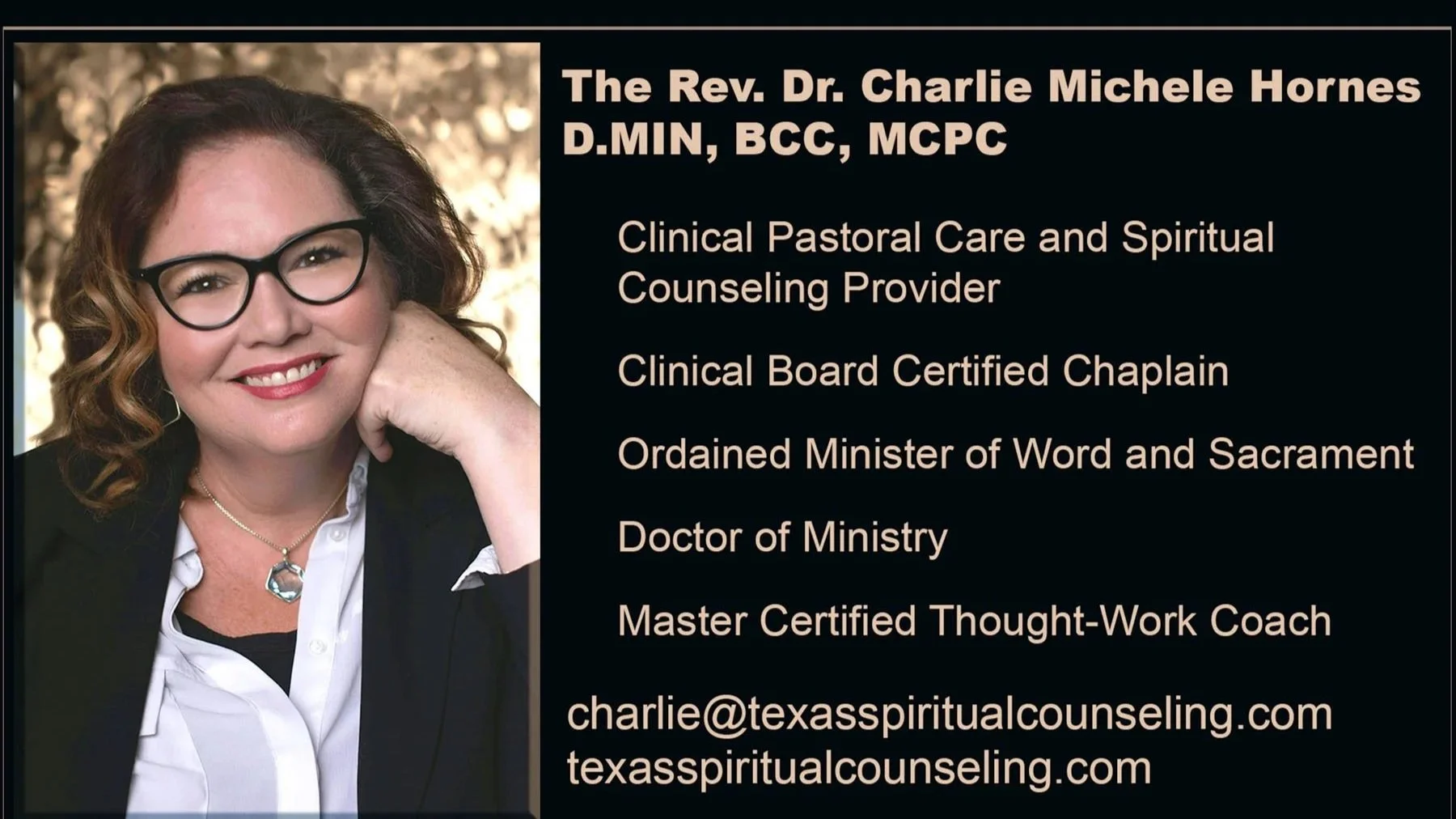
Dr. Charlie Michele Hornes, DMin, BCC, MCPC, is a Doctor of Ministry, Board Certified Chaplain, ordained PC(USA) Minister of Word and Sacrament, and clinical spiritual counseling provider with more than two decades of experience in clinical hospital chaplaincy, crisis response, pastoral counseling, grief care, moral injury support, higher education, and leadership environments
She provides doctorate-level clinical spiritual care and pastoral counseling for adults and families navigating grief, faith questions, anger at God, moral injury, disaster exposure, church and institutional harm, hard decisions, and survival responses under pressure, when high stress and anxiety hit.
The Rev. Dr. Charlie Hornes earned a Master of Divinity from Union Theological Seminary with Columbia Universities in New York City and her Doctorate of Ministry at Austin Presbyterian Theological Seminary, in Austin, TX.
Her post-graduate clinical internship was at Mount Sinai Morningside Hospital in West Harlem, New York City, and her post-graduate clinical residency was with Baptist Health Systems in San Antonio, Texas, earning over 3600 supervised clinical hours in pastoral and spiritual counseling.
The Rev. Dr. Hornes has worked for over two decades in faith settings - hospitals, churches, addiction recovery, emergency rooms, ICUs, surgery, cancer centers, adult, pediatric and perinatal palliative care and hospice, COVID ICUs, university and spiritual retreat settings, and post-crisis emergency response teams for the Uvalde school shooting, the Kerrville and Texas Hill Country floods of 2025, and in New York City during 9-11.
Schedule Initial Spiritual Care Consultation
When the Reaction Happens Before the Decision Can Have a Chance
Maybe someone has told you:
“Stop taking things so personally.”
“Stop being so sensitive.”
“You’re overreacting.”
“Calm down.”
“You need to think before you talk.”
“Why didn’t you say something?”
“You should have handled that differently.”
“Get thicker skin.”
“Why can’t you just get over it?”
“You’re reading too much into it.”
“Stop trying to make everyone happy.”
“You always shut down.”
“You’re too defensive.”
“Not everything is a red flag.”
“Stop catastrophizing.”
That kind of feedback does not teach your body what to do next.
It just adds shame to a natural reflex.
Maybe when stress hits, your reaction happens before you have time to sort out what is true.
Maybe you clap back fast and regret the tone later.
Maybe you pull away, avoid, leave, or go silent.
Maybe your thoughts freeze and the words come back hours after the conversation is over.
Maybe you say yes before the “no” can get out.
Maybe you track every shift, every pause, every change in tone, every small sign that something is about to go wrong.
From the outside, these reactions often get mislabeled as personality problems.
But inside, something more specific may be happening.
Your body may be reading conflict, grief, uncertainty, visibility, responsibility, family tension, workplace dysfunction, church harm, disaster exposure, or spiritual distress and is responding before your thinking brain has fully sorted the facts.
That first reaction is not random.
It is a survival response.
This matters in grief.
It matters when anger at God shows up after loss.
It matters when moral injury leaves guilt, regret, responsibility, or the memory of what could not be stopped.
It matters when family members become hostile, passive-aggressive, avoidant, blaming, or emotionally unsafe.
It matters when church harm, workplace harm, relational conflict, or disaster aftermath leaves your body acting before your mind has language.
Maybe you have spent years wishing you could just act like “normal people.”
Maybe you have been told the reaction is the problem.
Maybe no one has ever helped you understand what the reaction is doing.
That is the missing piece.
Clinical spiritual care and survival-instinct neuro-behavioral thought work helps to identify what your system does under stress, what it learned to guard, what activates the reflex, and where the interruption point begins.
The work is practical.
Name the reflex.
Locate the trigger.
Slow the automatic response.
Choose the next step before the next apology, silence, exit, argument, shutdown, or over-explanation takes over.
This does not mean something is wrong with you.
It means your system learned how to survive difficult people and circumstances.
Now the work is learning how to interrupt the reflex when survival mode is no longer the best reaction for you.
If you already know this is affecting your grief, faith, decisions, relationships, work, or daily life, start with an Initial Spiritual Counseling Consultation.
If you are not sure which survival instinct is taking over in the moment, take the Survival Instinct Quiz first. It will help identify the reflex that keeps showing up under stress, and point you toward the next right step.
The Services We Provided:
First Step
Initial Spiritual Care Consultation
A focused first session to clarify the presenting issue, identify the pressure point, and determine the next right step for your care plan, referral, or ongoing support.
Referral and Care Plan Direction Session
For people unsure whether they need pastoral counseling, coaching-informed strategy, licensed therapy, medical care, or a combination of support.
Clinical Spiritual Care and Pastoral Counseling
Clinical Spiritual Care
For adults facing grief, moral conflict, faith questions, disaster exposure, family pressure, workplace harm, or life decisions that should not be forced into a diagnosis before they are understood.
Pastoral Counseling
Faith-informed care for people working through grief, anger, guilt, belief questions, church harm, spiritual distress, or major life decisions with God, religion, or meaning somewhere in the room.
Anger at God and Loss of Belief Support
A place to bring anger, doubt, numbness, disbelief, religious confusion, or the question, “How could this happen?” without being corrected, preached at, or rushed toward easy answers.
Faith and Church Harm Support
Support after spiritual harm, church conflict, religious manipulation, leadership betrayal, loss of trust, or the recognition that a place once called safe no longer feels safe.
Spiritual Discernment
For decisions where faith, calling, family, responsibility, grief, or identity are tangled together and the next step is not obvious.
Grief, Disaster, and After-Trauma Care
After-Trauma Spiritual Care
For survivors, responders, families, and community members carrying grief, anger at God, loss of belief, disaster exposure, or the burden of what they saw and could not stop.
Disaster and Responder Spiritual Care
For emergency responders, helpers, clergy, medical workers, volunteers, and community leaders who carried what others could not see and need a place to tell the truth about it.
Grief After Sudden Loss
Care for people carrying death, child loss, traumatic loss, family grief, community tragedy, or the kind of sorrow that changes how the world feels.
Moral Injury Support
Care for people carrying guilt, regret, responsibility, impossible choices, or the memory of what happened when every available option came with a cost.
Work, Leadership, and High-Responsibility Life
Workplace and Institutional Harm Support
Support after workplace betrayal, leadership conflict, public discrediting, retaliation, impossible expectations, or being treated like the problem for naming what was happening.
High-Functioning Burnout Support
For adults who are still showing up, still handling responsibility, and still getting things done while privately knowing the current pace, role, or room cannot continue the same way.
Leadership, Calling, and Vocation Support
Support for leaders, clergy, caregivers, educators, healthcare workers, and high-responsibility adults carrying decisions that affect more than one life.
Caregiver and Helper Support
For people who are usually the steady one: clergy, chaplains, nurses, teachers, parents, responders, nonprofit leaders, and caregivers who need support outside the systems that depend on them.
Decision, Family, and Survival-Instinct Work
Hard Decision Support
For decisions involving staying, leaving, speaking, reporting, forgiving, resigning, caregiving, family boundaries, faith, work, marriage, ministry, or identity.
Family, Faith, and Grief Conversations
Support for hard conversations around death, belief, caregiving, estrangement, forgiveness, family systems, or what can no longer be left unsaid.
Survival-Instinct Thought Work
Practical support for recognizing repeated reactions under stress, naming the body’s protective response, and building clearer language before the next decision, conversation, or conflict.
Support Alongside Therapy
Clinical spiritual care can stand alone when pastoral counseling is the right fit. It can also work alongside licensed therapy when mental-health care is needed.
Clinical Spiritual Counseling
Spiritual distress does not always look religious.
It can show up as grief, guilt, anger, loss of meaning, hard decisions, family conflict, church harm, workplace harm, moral injury, disaster exposure, or the sense that life has become too heavy to carry the same way.
Clinical spiritual counseling gives people a place to examine what happened, what it cost, what it means, what needs care, and what comes next.
This work may include:
grief, loss, and life after trauma
anger at God or loss of belief
church harm or religious conflict
moral injury and unresolved responsibility
workplace or institutional harm
decision support under stress
family and relational pressure
survival-instinct pattern recognition
thought work and cognitive reframing
nervous-system education
practical next steps
This is not about forcing a positive interpretation.
It is about getting honest enough to know what kind of care is actually needed.
Schedule Initial Spiritual Care Consultation
Survival-Instinct Neuro-Behavioral Thought Work
The Survival Instinct framework helps identify the reflex that tends to activate under stress.
Fight.
Flight.
Freeze.
Fawn.
Scan. (hyper-vigilance)
These are not personality types.
They are learned protective responses.
The goal is not to eliminate the response.
The goal is to notice it earlier, understand what it is trying to protect, and create more choice before the old reflex runs the moment.
Schedule Initial Spiritual Care Consultation
Where Many People Begin
Take the Survival Instinct Quiz
The quiz helps identify which survival response may be most active under stress.
It is a practical starting point for people who want language for the reaction that keeps showing up when stress rises.
Take the Survival Instinct Quiz
Digital Toolkits + Workbooks
After taking the quiz, many people begin with the toolkit that matches their result.
Each workbook is built as a practical field guide, not a journal.
The toolkits include teaching, visual maps, reflection pages, pattern tracking, micro-interruption tools, and repeatable exercises for real situations.
They help connect the dots between:
what happened
what the brain made it mean
what the body did next
what pattern repeated
what could shift earlier next time
Masterclasses + Digital Courses
The on-demand masterclasses teach the frameworks behind the work.
Topics include:
thought work and cognitive reframing
survival response patterns
post-trauma distress and processing
stress and nervous-system behavior
decision clarity under pressure
confidence built through evidence
relational and workplace pressure patterns
These classes are designed for people who want practical tools without vague personal-growth content.
Private Sessions
Private sessions provide confidential, structured support for what is happening in real life.
Clients often bring:
grief or sudden loss
anger at God or loss of belief
disaster exposure
church harm
moral injury
a difficult decision
workplace harm
leadership conflict
family pressure
a repeated relational pattern
a survival response that keeps taking over
loss of direction
Sessions may include clinical spiritual care, survival-instinct mapping, thought work, decision support, nervous-system education, and practical next steps.
Available virtually and in Hill Country Texas.
Schedule Initial Spiritual Care Consultation
About The Rev. Dr. Charlie Michele Hornes
Dr. Charlie Michele Hornes, DMin, BCC, MCPC, is a Board Certified Clinical Spiritual Provider, ordained minister, master certified thought-work strategist, doctoral researcher, and host of The Art of Managing Your Brain. She is an Ordained Minister of Word and Sacrament within the Presbyterian Church, USA.
Her background includes hospital chaplaincy, trauma-informed spiritual care, crisis response, higher education, leadership support, systems consulting, and doctoral research on survival response, institutional stress, and burnout-like patterns in high-functioning women.
She earned her Master of Divinity Degree from Union Theological Seminary in New York City and her Doctor of Ministry Degree from Austin Presbyterian Theological Seminary in Austin, Texas.
Charlie is a Board Certified Chaplain through the Association of Professional Chaplains and the Board of Chaplaincy Certification Inc.
She has worked in rooms where grief is not theoretical, decisions carry consequences, and easy answers are not enough.
Her private practice integrates:
clinical spiritual care
practical theology
survival-instinct thought work
neurobiology-informed education
behavioral pattern mapping
somatic awareness
decision strategy
coaching-informed support
The work is direct, structured, and grounded.
With Texas Spiritual Counseling, you will find a serious practice for adults who need language, clarity, and tools for what keeps happening under stress.
Start Here
Choose the path that fits:
Take the Survival Instinct Quiz
Best for identifying the survival instinct reaction and response pattern.
Explore Digital Toolkits
Best for self-paced pattern work and practical exercises.
View Masterclasses
Best for learning the thought-work and nervous-system frameworks on-demand.
More cost effective and can be done in tandem with private sessions.
Schedule Initial Spiritual Care Consultation
Best for private support around grief, faith questions, disaster exposure, hard decisions, workplace harm, family pressure, or a repeated response pattern.
If this fits, here’s your next step.
Clinical spiritual care for grief, trauma, faith questions, moral injury, hard decisions, and the part of the crisis that should not be forced into a diagnosis before it is understood.
Some crises do not start as mental-health disorders
Sometimes the problem is grief.
Sometimes it is anger at God.
Sometimes faith no longer fits the facts.
Sometimes an institution caused harm and everyone keeps calling it stress.
Sometimes the body reacts before the decision is clear.
Sometimes the person is still functioning, still leading, still caring for everyone else, and still privately aware that something cannot keep going the same way.
This work is for the part of the crisis that should not be forced into a diagnosis before it is understood.
Pastoral counseling and clinical spiritual care can stand on their own when spiritual care is the right fit. They can also work alongside licensed therapy when mental-health care is needed.
No forced belief.
No easy answers.
No turning every human crisis into pathology
If this fits, the next step is an Initial Spiritual Care Consultation.
General Services Provided
Pastoral Counseling for Grief, Faith Questions, and Hard Decisions
After-Trauma Spiritual Care for Disaster Exposure and Responder Burden
Anger at God, Wrestling With or Loss of Belief, and Church Harm Support
Support Alongside Licensed Mental Health Therapy
Private Pay + Reimbursement Documentation
Available Virtually Nationally, Across Texas, and Locally in The Texas Hill Country
Clinical Spiritual Care
Pastoral Counseling
Faith Questions and Loss of Belief Support
Anger at God Support
Spiritual Discernment
Church Harm / Spiritual Trauma Support
Grief, Trauma, and Disaster Care
After-Trauma Spiritual Care
Disaster and Responder Spiritual Care
Grief After Sudden Loss
Child Loss and Community Tragedy Support
Moral Injury Support
High-Responsibility Life Events and Support
Hard Decision Support
Leadership, Calling, and Vocation Support
Workplace and Institutional Harm Support
Caregiver and Helper Support
Life Change and Identity/Meaning Making Support
Support Coordination
Initial Strategy Session
Support Alongside Therapy
Referral and Care Plan Direction Consultation
Clinical Spiritual Care, Pastoral Counseling, and Survival-Instinct
Neuro-Behavioral Thought Work
Insurance + Reimbursement Documentation
FAQ: Can I submit sessions for reimbursement?
Sessions are private pay. I do not bill insurance directly and I am not an in-network insurance provider.
Upon request, I can provide an itemized receipt for clients who want to attempt reimbursement through insurance, EAP, HSA/FSA, employer assistance, church assistance, disaster-relief, or another reimbursement source.
When appropriate, receipts may include chaplain service documentation codes such as Q9001, Q9002, or Q9003. Reimbursement is not guaranteed and depends on the client’s plan, payer rules, and benefit structure.
Services are pastoral counseling and clinical spiritual care, not psychotherapy, diagnosis, medical care, psychiatric care, or treatment of mental-health disorders.
Location
Clinical Spiritual Counseling and strategy sessions in Kerrville, Texas, The Texas Hill Country, and clients across the United States with Virtual Sessions.
Virtual sessions available across Texas. In-person Hill Country Texas appointments by arrangement when available.
Book Spiritual Counseling
Booking your appointment is simple, and our team is ready to provide the attention, care, and expertise you deserve. Let’s get started—pick a time that works for you.
What People Are Saying
-
![A woman with short gray hair wearing a dark blazer and a blue blouse with red floral pattern, smiling against a plain light gray background.]()
“Let me tell you, she is just fantastic at teasing out the truth and the deeper reasons why we are who we are, and we react the way we do, as well as being a fun person to talk to.”
~ CMSgt Casy Boomershine, MHRM, SPHR
Retired Air Force Command Chief
Human Resource Business Partner and Human Resource Manager at Spectrum
Public Speaker
-
![Joanna Rajendran Keynote Speaker, Mindset Mastery Coach, Author of MY GURU WEARS HEELS & the upcoming book BEST. LIFE. EVER.]()
"Charlie’s wisdom and insight are matched by her wit and relatability. Everyone will want to tune in to everything she does!"
Joanna Rajendran
Keynote Speaker, Mindset Mastery Coach, Author of MY GURU WEARS HEELS & the upcoming book BEST. LIFE. EVER.
-
![Sraboni R., Dedicated Viewer]()
“Your videos have had such an impact that I couldn’t hold back—I’ve been binge-watching your content, and it even made its way into my dreams thinking about making these changes for myself - it was so unforgettable.“
Sraboni R.,
Dedicated Viewer
-
![American woman with curly hair wearing pearl necklaces and earrings, standing in front of an American flag.]()
"Charlie is very talented and professional in all aspects of her work. She has a way of making you feel comfortable to share your thoughts in a way that does not feel awkward. I was blessed to share my experiences and hopefully encourage others. Keep being Great!"
Mayor Mary Dennis,
Mayor, The City of Live Oak, Texas
-
![A smiling woman with long dark hair, wearing glasses and earrings, outdoors in a park.]()
"Dr. Charlie Hornes offers hands-on, practical advice for those dealing with trauma and life’s tough challenges. Her insights are a game-changer for anyone seeking to heal and grow into a healthier self."
-
![A woman with shoulder-length brown hair smiling, wearing a denim jacket and earrings, against a plain background.]()
Dr. Charlie Hornes is the real deal! She knows how life experiences, circumstances and cultural norms influence all human relationships. Learning from her is enlightening, challenging, and practical!
Lynette Solomon, MDiv, BCC
-
![A woman with shoulder-length brown hair, wearing glasses and a colorful patterned top, smiling and posing against a plain white background.]()
"This is one of those podcasts that will stick with you..."
~ Janina S.
Podcast Community
-
![A man wearing sunglasses, a blue bandana, and a blue jacket sitting on a black motorcycle outdoors.]()
"Charlie is a sponge for knowledge, always one step ahead in applying what she’s learned. Now, I’m learning deeply from her. Her blend of formal education, research, and life experience makes her guidance invaluable. She’s not just a coach—she’s a mentor."
~ The Rev. Jonathan M.,
Head Pastor, Spiritual Leader,
Master Educator, All-around kindest human
-
![Mehedi H. Subscriber and Regular Listener]()
“Your YouTube channel is incredibly engaging! The content is both instructive and informative, with top-notch production quality and clear passion in every video. I’m hooked—keep up the fantastic work!”
Mehedi H.
Subscriber and Regular Listener
-
![Woman celebrating holding a YouTube Silver Play Button award with a microphone in front, wearing glasses and smiling.]()
Did you know that The Charlie Hornes Coaching Studio has a Youtube Podcast Channel? Our Channel is about to hit 350,000 SUBSCRIBERS in ONLY 6 MONTHS!! Clearly our content is resonating! @charliehornescoaching
~ The Art of Managing Your Brain Podcast Youtube Channel
-
![A woman with short curly hair in a black top and pink scarf, sitting in a café holding two Starbucks coffee cups labeled 'Sali' and 'Dr. Charlie.' She has a playful expression.]()
"Your authentic energy is showing in all of your posts! Your episode about "Why burnout feels like a loop you can’t escape and what you can do to break free" is so insightful! The actionable takeaways, like the "Burnout Audit" and "Recalibration Routine," are such practical ways to reclaim our energy. 💪🌿 The "Reclaim Your Morning" tip is so simple yet powerful! ☕️✨ Thanks for sharinggg, Dr. Charlie! 🙌 "
Sali Bina
Regular Listener, Subscriber







Your Questions, Answered
-
No. This is not psychotherapy, diagnosis, medical care, psychiatric care, or treatment of mental-health disorders.
Texas Spiritual Counseling provides pastoral counseling and clinical spiritual care. The work focuses on grief, faith questions, moral injury, spiritual distress, hard decisions, disaster exposure, and the parts of a crisis that need language before they are forced into the wrong category.
-
Yes, for clients who are specifically seeking Christian counseling.
The work can include Christian faith, scripture, prayer, theology, church experience, spiritual struggle, anger at God, or questions of calling and meaning when the client wants that included.
It is also not limited to Christian clients.
-
No.
Clients may be Christian, interfaith, spiritual-but-not-religious, agnostic, atheist, unsure, done with church, or carrying no formal belief system at all.
The work begins with the person in front of me, not with a required belief statement.
-
Yes.
Anger at God, loss of belief, numbness, doubt, guilt, grief, and the question “How could this happen?” are all welcome here.
This is not a space for forced answers, religious correction, or spiritual bypassing.
-
Yes.
Clinical spiritual care can stand alone when pastoral counseling is the right fit. It can also work alongside licensed therapy when mental-health care is already involved or needed.
With client permission, coordination or referral can happen when appropriate.
-
No. Sessions are private pay. I do not bill insurance directly.
-
Yes. Upon request, I can provide an itemized receipt for clients who want to attempt reimbursement through insurance, EAP, HSA/FSA, employer assistance, church assistance, disaster-relief, or other benefit programs.
Reimbursement is not guaranteed and depends on the client’s plan, payer rules, and benefit structure.
-
No.
This practice does not provide emergency, crisis, medical, psychiatric, or suicide-intervention care. If there is immediate danger, call 911, go to the nearest emergency room, or contact a local crisis resource.
-
Yes.
Virtual sessions are available across Texas. In-person appointments may be available by arrangement in Hill Country Texas.
-
Yes.
Clinical spiritual care is not limited to religious clients. Many people need support around meaning, grief, guilt, anger, loss, responsibility, or what no longer makes sense, whether they believe in God or not.